Sundarban private tour where shadows move softly – Nature reveals itself slowly
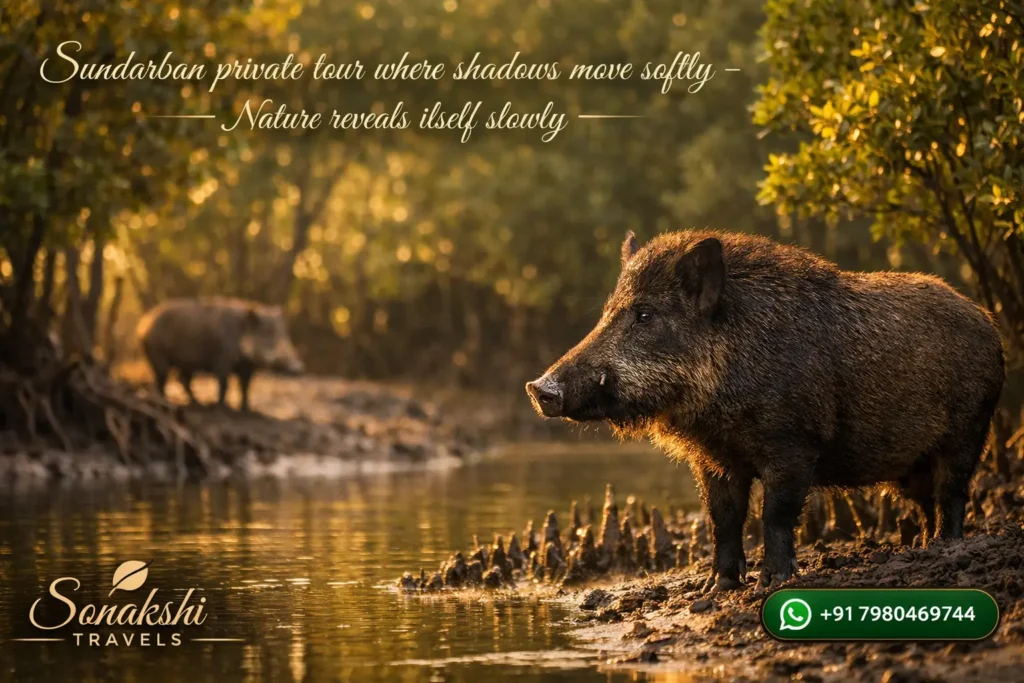
A Sundarban private tour is not a journey that should be understood through speed. It is not a place that gives away its truth in one bright scene. The Sundarban is a forest of slow signs, layered silence, shifting light, and patient revelation. Here, shadows move softly over tidal water, across mangrove roots, along muddy banks, and through narrow creeks where the forest seems to breathe in secret. That is why nature reveals itself slowly in this landscape. It is not hidden out of refusal. It is hidden because this is the natural rhythm of the delta.
Many destinations make their beauty clear at once. The Sundarban does not work in that way. Its beauty grows through attention. A traveler may first notice the river, then the stillness, then the changing light, and only later the deeper texture of the living environment. A bend in the creek may seem simple at first, but after some time it begins to feel charged with presence. The water carries reflection, movement, silence, and uncertainty together. In a private journey, this delicate mood can be experienced fully because the traveler is not being pushed by crowd rhythm or distracted by unnecessary noise.
This is one reason a private tour in the Sundarban feels so different from an ordinary group outing. Privacy changes not only comfort but also perception. When the boat is quieter, the forest becomes easier to read. When the journey is more personal, the senses begin to work more deeply. The traveler notices the way the air grows heavier near the mangrove edge, the way birds break silence for a brief moment, and the way evening shadows slowly gather over the river. These are not small details. They are the real language of the landscape.
The Sundarban is a forest of gradual discovery
The title says something very true about the region. In the Sundarban, shadows do move softly. They do not fall sharply in the way they may in a dry open land. Here the light is filtered through moisture, leaves, mist, river reflection, and dense vegetation. The result is a softer atmosphere, one that changes from hour to hour. In early morning, the forest often appears half-awake, as if the land is still holding the last silence of night. At that time, every movement feels gentle. Even the boat seems to enter the landscape with care.
The second part of the title is just as important. Nature reveals itself slowly because the Sundarban is not a place of full visibility. It is made of creek lines, hidden banks, half-seen clearings, and channels where life remains partly concealed. A traveler does not always see a complete picture. Instead, the forest gives fragments. A movement in tall grass. A ripple near the mud edge. A bird lifting suddenly from a low branch. A set of marks on wet soil. These fragments create a deeper kind of attention than a place that shows everything at once.
This slow unveiling is closely related to the feeling expressed in this quiet private tour where adventure moves with the forest. The idea matters because adventure in the Sundarban is not only about excitement. It is about entering a world where observation becomes more important than noise. The true adventure is learning how to notice what the landscape is already saying.
Why a private tour changes the experience
A private boat safari in the Sundarban gives the traveler something that is increasingly rare in modern travel: mental space. Without the constant movement of a large group, the journey becomes calmer and more exact. The eye can rest. The ear can listen. The body adjusts to the rhythm of tide and boat. This matters greatly in a mangrove region where the most powerful moments are often the quietest ones.
In a group setting, it is easy for the forest to become background. People talk, take quick photos, and move on. In a private setting, the forest returns to the center of attention. The traveler begins to sense how much the landscape depends on timing. A creek that looks open in one hour may look secretive in another. A bank that seems still may suddenly reveal bird life. A wide channel under morning light may feel completely different by dusk. Private travel allows one to stay with these changes long enough to understand them.
That is why a luxury private tour or an exclusive river journey is not only about comfort. It is also about quality of seeing. The Sundarban rewards those who move gently. When the boat is not crowded, when the pace is not rushed, and when the traveler is emotionally present, the landscape begins to feel far richer. The forest is no longer a distant scene. It becomes a living environment that acts on the mind.
The role of silence in a mangrove landscape
Silence in the Sundarban is never empty. It holds birds, water, insects, wind, and hidden motion. Yet it remains silence because no single sound dominates for long. This gives the region a rare emotional tone. In a private journey, that tone can be felt much more clearly. A traveler learns that silence here is not absence. It is a kind of fullness.
The forest does not need loud drama to feel powerful. A still river under slanting light can carry more force than a crowded viewpoint. A pause in the boat engine can reveal more than a long explanation. The traveler begins to sense that the Sundarban is not demanding attention. It is inviting attention. That is a major difference. Places that demand attention often become tiring. Places that invite attention become unforgettable.
This quality is beautifully connected with the mood suggested in a Sundarban private tour where rivers breathe mist and dawn opens slowly. The phrase captures the true emotional character of the delta. The rivers here do seem to breathe mist in the first hours of the day, and that mist softens the whole world. In such moments, the forest is not simply seen. It is felt.
Light and shadow shape the meaning of the journey
In many places, light only helps us see. In the Sundarban, light changes the feeling of reality itself. Dawn light gives the forest tenderness. Midday light sharpens edges and reflections. Evening light deepens mystery. With every shift, shadows move and stretch differently. Because the land is broken by water, roots, branches, and tidal mud, these shadows are always active. They are never flat. They slide across surfaces and disappear into channels. They create a landscape that seems to change even when it is still.
This is one of the main reasons why nature reveals itself slowly here. Light decides how much the eye can understand. Some forms become visible only at a certain angle. Some details appear only when the sun softens. The same river bend may look welcoming in the morning and guarded in late afternoon. The same forest edge may seem ordinary from a distance and richly alive when observed for longer. A private tour gives the traveler enough time to experience these visual changes as part of the meaning of the place.
A thoughtful mangrove forest tour therefore becomes more than movement from one point to another. It becomes a study of tone, mood, and gradual perception. The traveler learns that the Sundarban is not one fixed image. It is a changing conversation between river, sky, vegetation, shadow, and tide.
The river teaches patience
No one can understand the Sundarban without understanding patience. The region is governed by tidal time, not human hurry. Water rises, falls, turns, and returns. Routes shift with conditions. The forest gives access in measured ways. This is why a private journey is so valuable. It allows the traveler to accept the rhythm of the place instead of fighting against it.
Patience changes the quality of sight. At first, many travelers look only for obvious spectacle. But after an hour or two on the river, the eyes begin to slow down. They become ready for subtler forms of beauty. The line of mangrove roots against wet soil. The brief appearance of a kingfisher. The delicate movement of leaves in still air. The cautious shape of life near a hidden bank. These moments would mean very little to an impatient traveler. To a patient one, they become the essence of the journey.
The slug from the first link, built around the idea of private tour and adventure, gains fuller meaning here. In the Sundarban, adventure is not always loud, fast, or dramatic. Often it is the adventure of waiting, of noticing, of entering a place that does not explain itself immediately. That form of adventure is quieter, but it is also deeper.
Wildlife belongs to the atmosphere, not only to sightings
The Sundarban is widely known for wildlife, yet the region should never be reduced to the hope of one major sighting. Its ecological richness is broader than that. In this forest, wildlife is inseparable from habitat. Birds, reptiles, fish, deer, crustaceans, and the famous tiger all belong to a world shaped by salinity, mud, cover, tide, and concealment. A Sundarban river cruise or private safari helps the traveler understand this living connection much better than a rushed visit can.
Because visibility in the mangrove zone is partial, the experience of wildlife is often indirect as well as direct. One may see a crocodile resting near the bank, deer watching from partial cover, or birds flashing across a creek. But one may also feel wildlife through signs, movement patterns, and sudden changes in the mood of the environment. This does not weaken the experience. It strengthens it. The forest feels more real when it is not reduced to a staged display.
A private tour helps this truth settle into the mind. The traveler stops thinking only in terms of success or failure of sighting. Instead, the whole ecosystem becomes meaningful. The shadows under branches, the still water near exposed roots, the watchfulness of the open bank, and the silence between sounds all begin to feel like part of one living order.
Seeing less, understanding more
This may sound strange at first, but in the Sundarban, seeing less can sometimes lead to understanding more. A place that reveals everything immediately leaves little room for imagination, humility, or concentration. A place that reveals itself slowly asks the traveler to participate. The mind must stay open. The senses must remain active. Memory begins to work more deeply because each impression is earned through attention.
That is why so many thoughtful travelers later remember not only animals, but atmosphere. They remember the weight of mist at dawn. They remember a half-dark creek. They remember the way the river seemed to hold both silence and movement at the same time. They remember feeling small in a good way. This is one of the greatest strengths of a private Sundarban experience. It allows the place to work inwardly.
The emotional truth of a slow forest
Modern travel often rewards speed. It values how much can be covered, counted, and displayed. The Sundarban quietly resists that approach. It asks the traveler to stay, watch, and let the place enter gradually. This is not a weakness of the destination. It is its deepest strength. A slow forest creates a slower mind. A slower mind sees more honestly.
When people return from a private journey in the Sundarban, what often stays in memory is not one single dramatic scene. It is the overall feeling of being inside a living, tidal, breathing world. The river seemed older than speech. The trees seemed rooted in silence. The mist seemed to soften the border between water and sky. The shadows seemed to move with intention, though nothing was forced or theatrical. That memory stays because it was formed through attention, not distraction.
This is also why the title remains so accurate from beginning to end. A Sundarban private tour is truly a journey where shadows move softly and nature reveals itself slowly. The phrase is not decorative. It describes the real structure of the experience. The forest offers beauty, but in layers. The river offers movement, but without haste. The light offers clarity, but only in passing intervals. Together they create a travel experience that is quiet, serious, and deeply moving.
Why this kind of journey feels complete
A journey feels complete when it changes the traveler’s way of seeing. That is what a private Sundarban tour can do. It teaches that beauty does not always arrive with force. It teaches that silence can carry meaning. It teaches that the natural world does not need to rush in order to be powerful. These lessons stay long after the boat returns.
The traveler leaves with more than photographs or passing impressions. There is a stronger inner memory: water turning silver in early light, mangrove shadows crossing the mudbank, a hidden creek opening without warning, and the feeling that the forest never once tried to impress, yet impressed deeply all the same. That is the mark of a true landscape. It does not shout. It remains.
In the end, a private tour in the Sundarban is valuable not because it isolates a person from the world, but because it brings the person closer to the world that truly exists there. It allows the delta to be experienced on its own terms. In that patient, river-led, shadow-filled space, nature begins to reveal itself slowly, and because it comes slowly, it enters the mind more deeply. That is why the journey feels so gentle while it is happening, and so powerful after it is over.